
FAQ
General & heritage questions
A: Benford UV Lamps is the official successor to the Primarc legacy. We acquired the complete Primarc UV intellectual property, technical archives, blueprints, and manufacturing tooling. Most importantly, our lamps are produced in Buckinghamshire by the original Primarc technical team, ensuring 100% continuity in quality and engineering standards.
A: Yes. While we are the OE manufacturer for Benford UV systems, we specialise in producing high-quality replacement lamps for almost all global UV curing brands, including GEW, IST, Gallus, Hanovia, and many others.
Ordering & lamp identification questions
A: Absolutely. 99% of our customers simply provide a part number or email us a clear photo of the lamp and its end-cap markings. If those aren’t available, we can manufacture a technical match from five key measurements: Overall Length, Shoulder-to-Shoulder Length, Arc Length, Diameter, and Lead Length.
A: No. Whether you need a single replacement lamp for a bespoke project or a bulk supply for a large printing facility, we cater to orders of all sizes with the same level of precision and care.
Technical specification questions
A: All our lamps are manufactured to provide a high level of curing efficiency for at least 1,000 operating hours. With proper handling and cooling, many of our lamps maintain over 80% of their original output well beyond this period.
A: Doping is the process of adding small amounts of metal halides (like Iron or Gallium) to the mercury dose.
-
Iron (Fe) shifts the output for better curing of thick, opaque whites.
-
Gallium (Ga) is used for deep penetration of heavily pigmented coatings. If you aren’t sure which you need, our team can advise based on your specific ink or coating chemistry.
A: Yes. We can manufacture lamps using specialised doped quartz that filters out the vacuum-UV wavelengths (below 200nm) responsible for ozone generation, making them ideal for facilities without specialised extraction systems.
Maintenance & handling questions
A: Natural oils from your skin can leave residues on the quartz. When the lamp reaches its operating temperature (up to 800°C), these oils can cause clouding (devitrification), which permanently reduces UV transmission and creates hot spots that can lead to premature lamp failure.
A: If a lamp becomes contaminated, it should be cleaned with an industrial alcohol wipe or a lint-free cloth dampened with isopropanol (IPA) before ignition.
Place an order
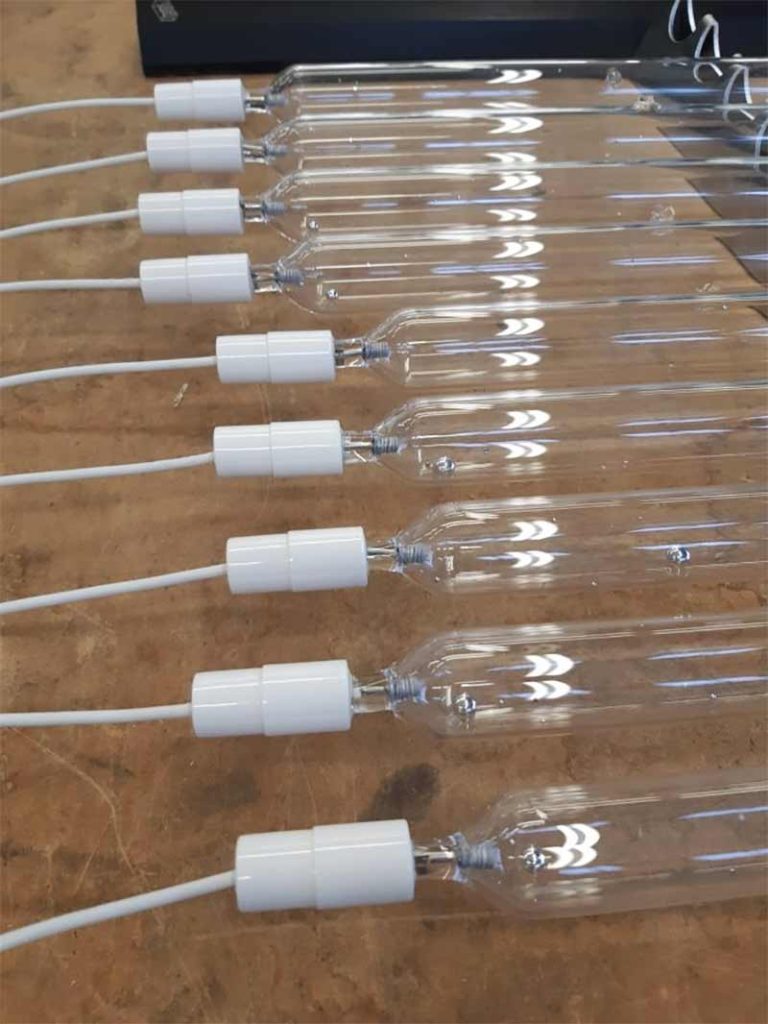
Ordering replacement UV lamps is easy, simply complete our order enquiry form by providing us with your lamp part number – usually found on your existing lamp – and a photo that shows the complete unit, including end caps. 99% of lamps can be instantly identified this way.
If your lamp markings have worn away or aren’t available, our engineers can still manufacture a 100% technical match, we just need a few key measurements:
Lengths. Overall length, shoulder to shoulder and arc length.
Width. The diameter of the quartz body.
Connections. The length of the electrical leads on each side.
Chemistry. Let us know if you are curing standard inks (Mercury) or thick, pigmented coatings (Iron of Gallium Doped).